This website is maintained by Belinda Medlyn, Yan-Shih Lin and Remko Duursma
Other team members: Colin Prentice, Almut Arneth
Background
Many (most) ecosystem models represent stomatal conductance (gs) using a variant of the empirical Ball-Berry model, in which gs is assumed to be proportional to the photosynthetic rate (A) multiplied by some function of humidity (f(hr)), divided by the atmospheric CO2 concentration (Ca):
$$ g_s = g_0 + g_1 A \frac{f(h_r)}{C_a} $$This relationship has two empirically fitted parameters, the residual conductance g0 and the slope g1. In the absence of evidence or theory to the contrary, most ecosystem models simple assume that g1is a fixed parameter for all C3 vegetation types.
However, we recently showed (Medlyn et al. 2011) that the parameter g1 has a functional interpretation. We started with the theory of optimal stomatal behaviour developed by Cowan and Farquhar (1977). This theory is based on the idea that stomata should act to maximize carbon gain (photosynthesis, A) while minimizing water loss (transpiration, E). That is, the optimal stomatal behaviour would be to maximise the integrated sum of (A - l E), where l (mol C mol-1 H2O) is a parameter representing the marginal carbon cost of water use. We showed that this assumption leads to an expression for stomatal conductance (gs) that is analogous to the Ball-Berry equation:
$$ g_s = g_0 + 1.6(1 + \frac{g_1}{\sqrt{D}} \frac{A}{C_a}) $$Importantly, the slope parameter, g1, is inversely proportional to the marginal water cost parameterl. That is, the slope of the stomatal model depends on the cost of water to the plant.
We hypothesise, therefore, that the slope parameter should vary in a predictable fashion. For example, we would predict that plants with a relatively high cost of water uptake and transport, such as plants with low hydraulic conductance or high wood density, should have low values of g1.
Aims
We want to test this theory! We would like to obtain stomatal conductance data sets for a wide range of species growing in a range of environmental conditions. Firstly, of course, we need to test how well our model performs. If the model performs sufficiently well, we then need to determine values of g1, and examine whether these are predictable from species ecology. We believe that this cross-species synthesis work will generate an important step forwards in our understanding of stomatal behaviour, and in our capacity to model vegetation water use.
(1) Preserve your data: We’ve already spoken to a number of researchers whose hard-won data have been lost; don’t let this happen to your data! Here is an easy way to preserve your data and make it available and accessible for ongoing research.
(2) Increased citations: Each data point will be associated with a reference; papers using the dataset will cite the reference associated with each data point.
(3) Dataset paper authorship: At the end of our project, we plan to contribute a paper to Dataset Papers in Ecology which would include all contributors as authors. At this stage the database will become public, freely and permanently available.
(4) Invitations to contribute intellectually: We will maintain a mailing list to keep you informed of what we are doing with your data. You’ll receive drafts of papers and we’ll give you the opportunity, if you wish, to contribute intellectually to the synthesis.
We need gas exchange data that include variations in stomatal conductance and corresponding assimilation rates and environmental data. Importantly, the stomatal conductance needs to reflect the environmental conditions – for example, diurnal measurements of gs or gs response curves. A-Ci curves are usually not useable because data points are taken too swiftly for gs to respond. We need raw data (i.e. individual data points), rather than averaged data or parameter values, because we want to test how well the model works and identify instances where it does not work. Any additional information about species traits is also helpful. A full list of the variables, required and desirable, is available here.
You can put your data into a spreadsheet and email it to us; we will then add it to the database.
A template for a typical data set can be found here (.xls file). Although feel free to send us data in a different format if it is easier.
We have developed a couple of packages that enable you to fit the model yourself if you wish:
For Python users, here is the package for stomatal model fittings
developed by Drs. Yan-Shih Lin and Martin De Kauwe
For R users, download the R-fitting package from Dr. Remko Duursma's website.
Medlyn B.E., Duursma R.A., Eamus D., Ellsworth D.S., Prentice I.C., Barton C.V.M., Crous K.Y., de Angelis P., Freeman M. & Wingate L. (2011) Reconciling the optimal and empirical approaches to modelling stomatal conductance. Global Change Biology, 17, 2134-2144.[Abstract]
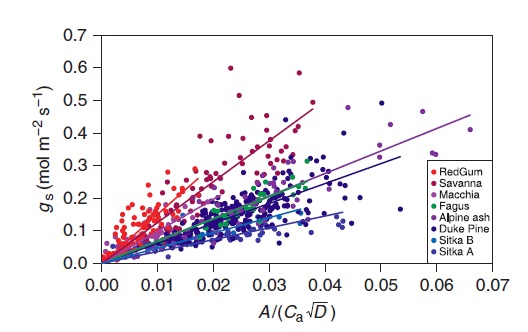
--This paper compared g1 values among eight different forest species and found that values tended to increase with temperature, and were higher in angiosperms than conifers. These differences are demonstrated in this figure, taken from the paper, which shows a visualization of the unified stomatal model fitted to eight datasets from contrasting forest ecosystems. Blue shades show data from conifers, green shows data from deciduous angiosperms, and red/purple shades show data from broadleaf evergreen forests. For this figure, the model and linear regressions were fitted fixing the intercept to zero.
Note: there was an error in this paper; this error is corrected in the Corrigendum.
--This paper fitted the stomatal model to diurnal gs curves obtained from four Eucalyptus species of different environmental origin growing in a common garden. We found that g1 parameter values were lower in the more drought-adapted species and that the reduction in g1 under drought was larger in the mesic species. We also found a correlation (across the four species) between g1 and hydraulic conductance.
This work is supported by ARC Discovery Grant DP120104055: Turning water into carbon : a synthesis of plant water use efficiency from leaf to globe (CI’s Medlyn, Prentice, Duursma, Arneth).